 |
Kitten Care 1 :: Vitals, Nutrition, Development, Determining Gender
Raising a healthy kitten ... At some point, you may find yourself in a situation where you are raising and nurturing an orphaned kitten. This Kitten Page will focus on basic care, and guidelines for feeding. Page 2 focuses on emergency considerations. Page 3 provides a dental chart, health indicator chart and a vaccination schedule. Page 4 provides detailed information on pregnancy and delivery. Page 5 is where you'll find our Kitten Shop. If you are ever in doubt about how to care for a newborn or older kitten, please never hesitate to contact your vet for help and resources.
Normal Kitten Vitals:
TEMPERATURE
In the first 2 weeks of life:
At 2-4 weeks of life:
To maturity:95°
97 - 99°
101 - 102.5°
WEIGHT
At birth:
Growth weight per week:90 - 110 grams
50 - 100 gramsNOTE: This is an approximate weight range for newborns. By the end of the first week, your kitten's weight should be doubled. A gram scale can be a helpful tool to keep a daily/weekly monitor of your kitten's weight to ensure she is developing at a normal rate.
Developmental Stages:
Can lift head:
Can maintain upright posture:
Eyes begin to open:
Eyes will remain blue:
Ears begin to function:
Startle reflex to noise:
Depth perception:
Tooth development:
Forelimb support:
Rearlimb support:
Start to play/interact:
Can voluntarily eliminate:
Able to graduate to solid food:at birth
at 2-3 weeks after birth
5-14 days after birth
approx. 2 weeks; true color within 3 months
6-17 days after birth
as early as day 3
by 4 weeks of age
by 4 weeks of age
at 1-10 days after birth
at 14 days after birth
at 2 weeks after birth
at 3 weeks after birth
28-50 days after birthNOTE: This is a basic guideline for developmental stages. Not all kittens will develop at this rate, but should be approximate to this guide.
* * * Please remember, newborn kittens do not develop a shivering reflex until they have reached at least 7 days of age. It is very important that your kitten is kept in a warm environment at all times * * *
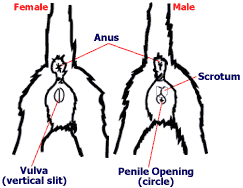
-----------------------------------Is Your Kitten Male or Female?
How to determine your kitten's gender:
-----------------------------------Nutrition and Feeding:
Your kitten is depending on you to provide her proper nourishment. If your kitten is a newborn, or has not yet reached 4-6 weeks of age, the following is a helpful guide to keeping her nutritional status as healthy as possible.
Kitten Formula:
A good kitten formula is fortified with essential nutrients needed for proper growth and development. Additional supplementation is only necessary when an emergency situation warrants it.
KMR Kitten Formula is an excellent milk supplement for feeding newborns until 4 weeks of age or older. This formula is available in both a pre-mixed liquid form and a dry powder form to be mixed with water (you can order KMR Here). Although the pre-mixed canned formula is convenient, it must be refrigerated upon opening and kept no longer than 48 hours. The dry powder is easy to measure and mix, and it has feeding directions for kittens on the label. After opening, the un-mixed dry powder can be kept in the refrigerator for up to 3 months. Once mixed, it should be refrigerated and stored for no longer than 24 hours.
NOTE: KMR Kitten Formula is available at any pet store or veterinary clinic. Also available are other formulas such as Havolac, Unilact, and Veta-Lac. KMR Kitten Formula is the most popular formula and the most available. Please read all mixing directions carefully and consult your vet should you have additional questions.
PRECAUTIONS: DO NOT feed raw or unpasteurized cow's milk, goat's milk, or other forms of whole milk products to your newborn kitten. These milk products can cause diarrhea, bloating, constipation, severe intestinal gastric upset and imbalances, as well as enzyme overload, toxoplasmosis, hypoglycemia, and other serious health concerns.
Nurser Bottles:
Pet-Ag manufactures great kitten nurser bottles, and can be purchased as kits that include extra nipples and bottle cleaners. These kits are available at any pet store or veterinary clinic.
NOTE: Most nipples supplied with a nurser bottle or kit are not pierced. Please remember to pierce the nipples before feeding. Make sure you can squeeze out a sufficient amount of formula from the bottle, this will ensure your kitten can adequately receive the proper amount during each feeding. Also remember that mixed formula should be lukewarm, never hot. Use care when using a microwave oven to heat formula, as the formula can be very easily overheated. Take special care in keeping kitten's bottles and nipples clean and sterilized before each feeding.
Feeding Directions:
In most cases the kitten formula will have feeding directions included on the label. Please follow them carefully and consult with your vet if you have additional questions or concerns.
NOTE: It is important to realize that each kitten is an individual and one kitten may need more or less nourishment than another. DO NOT overfeed or underfeed a newborn. In most cases a kitten will alert you when she has had enough at individual feeding times. If you overfeed her she will then be predisposed to constipation, bloating, gas, diarrhea, or other serious gastrointestinal complications. In newborns, these can be fatal. If you underfeed her, she may fail to gain weight, shiver, cry or vocalize excessively, appear weak and ill. In newborns, this can be fatal. Typically, newborns should be fed every 2-3 hours until 2 weeks of age, and then the feeding schedule can be gradually reduced to every 4-6 hours, depending upon your kitten's individual needs.
To feed your kitten using a kitten nurser bottle: gently position your kitten on a towel or blanket with her stomach facing down. Do NOT EVER hold a kitten on her back while feeding, this can cause fatal aspiration as fluid is drained into the lungs, aspiration pneumonia occurs and can be fatal within minutes to hours! ONLY feed your kitten with her stomach-side down. Next, hold the nurser bottle at a 45-degree angle and gently slide the nipple between her top and bottom gums; this may take a few seconds as she learns to accept the foreign-ness of the nipple. She should automatically start suckling from the nipple.
Equally important with newborn kittens is that they need to be stimulated to eliminate after each feeding. This stimulation is extremely important and is normally provided by momma kitty, but in her absence it is up to you to provide this function to ensure your kitten has healthy and normal urination/bowel functions. This can be accomplished by gently rubbing the penis/vulva area for urination and the anus for defecation with a soft dampened cotton ball or gauze pad. Use a clean cotton ball each for the vulva and for the anus! Kittens should urinate after each feeding and should have a bowel movement at least once daily, or at least 3-6 times daily. Your kitten's stool should be of a firm consistency and yellowish in color, not diarrhea or gray in color (which indicates dehydration and insufficient food intake). If you notice that your kitten has not urinated or produced a bowel movement in over 24 hours, you will need to contact your vet IMMEDIATELY. He may suggest sub-q fluid support and/or a warm water kitten enema, but NEVER attempt to do this yourself as it should be done at your vet's clinic. Unless you are experienced and have the necessary equipment, never attempt a kitten enema on a very young kitten. Never use human products, such as Fleet enemas, in cats as they are too dangerous.
KITTEN FORMULA FEEDING GUIDE
(It is assummed you are using a commercial kitten formula, such as KMR and have mixed it according to package directions). ***DO NOT feed any type of formula/milk product to a kitten who is hypothermic or weak, or does not have a suckling reflex, or appears to be suffering "fading kitten syndrome"! If such symptoms are present, get your kitten to an emergency veterinary facility immediately for veterinary care! Your vet will gradually increase kitten's internal body temperature to a safe level (via a properly warmed incubator, warm fluids or other warming methods) and may provide dextrose solutions to aid recovery BEFORE formula is to be fed. If a suckling reflex is not present, your vet will need to rule out cleft palate, a defect that occurs in some kittens before or at birth, and will need to utilize other feeding methods (i.e, tube-feeding).
Age In Weeks Average Weight of Kitten Amount of Formula Per Day Number of Feedings Per Day 1 Week 4 oz. (113.3 g.) Approx. 32 ml 8 2 Weeks 7 oz. (198.3 g.) Approx. 56 ml 6 3 Weeks 10 oz. (283.5 g.) Approx. 80 ml 4 4 Weeks 13 oz. (367.9 g.) Approx. 104 ml 3-4 5 Weeks 16 0z. (453.6 g.) Approx. 128 ml 3 NOTE: This chart is an estimate, you may need to slightly adjust amounts to fit the needs of the individual kitten.
Tips:
Ask your vet for a free (needle-less) 3ml syringe to help you measure (ml is equivalent to cc).
When purchasing kitten nurser bottles, choose one that is pre-marked with Tbsp's and Fluid Oz.
1 teaspoon = 5 ml
3 teaspoons = 1 Tablespoon
1 Tablespoon = 15 ml (1/2 fl oz.)
2 Tablespoons = 30 ml (1 fl oz.)
3 Tablespoons = 45 ml (1 1/2 fl oz.)
4 Tablespoons = 60 ml (2 fl oz.)
-----------------------------------* EMERGENCY Kitten Formula
(The following is to be used only in emergency situations where a commercial kitten formula is not available. They are NOT meant or formulated to be used long term)
HOMEMADE RECIPE FOR KITTEN FORMULA
3 oz. condensed milk
3 oz. water
4 oz. plain yogurt (NOT low-fat)
3 large or 4 small egg yolks
ANOTHER KITTEN DIET
1/2 cup whole milk
1 egg yolk
1 drop mulitple infant vitamins (Please ask your vet)Mix well or blend together in a blender for smoothest consistency.
DOSAGE (Divide and feed 4 times daily)
Age (in weeks)
1 week:
2 weeks
3 weeks *
4 weeksml /per 100 g. of body weight /per day
13 ml
17 ml
20 ml (* start encouraging solid food)
22 mlNOTE: This chart is an estimate, it may need to be slightly altered to meet the needs of the individual kitten. Always remember to consult your vet if you are ever unsure of feeding amounts or requirements. Never use these homemade diets for long term use.
KITTEN REHYDRATION FORMULA
This formula can be used for kittens suffering from dehydration and diarrhea. This mixture is thick but drinkable. It is just as effective as glucose-based oral solutions in preventing and treating dehydration and has the added advantage of reducing the volume and duration of diarrhea.
Cereal-based oral rehydration solution can be made by mixing:
1/2 cup dry, precooked infant's rice cereal
2 cups of water
1/4 teaspoon salt.NOTE: This solution should only be used temporarily. If you think your kitten is suffering dehydration and/or severe diarrhea, do not hesitate to see your vet immediately. Dehydration and persistent diarrhea in young kittens and cats can lead to serious organ failure, fever, shock, malnutrition and other serious health conditions.
-----------------------------------Bonding - A Vital Connection:
Bonding is a vital part of your newborn's survival and well-being. In the absence of your kitten's natural mother, you can be the next best thing. If the queen was available, she would keep her young one warm, safe, sound, and well nourished. An orphaned kitten needs to be supplemented in many ways and bonding is a way to provide her the best chances of survival, health, growth, and development. Your kitten needs to feel your warmth and your heartbeat to give her a sense of security and safety. It is your warmth and heartbeat she will feel that is most natural to that of her own mother's nurturing care. Take special care when feeding, stimulating, and developing this precious bond with your kitten, she needs you now more than ever. Continue this bond throughout her growing stages, and she will grow into a well-adjusted adult kitty, and will provide in return unconditional love and many, many rewards....
Please never lose sight of the fact that no matter how hard we try, we cannot always know the proper treatment and protocols for our orphaned babies. Please do not ever hesitate to call your vet or an emergency vet if you are ever in doubt about your baby's care. Your vet can answer your questions and concerns, and your kitten is depending on you to do what's best for her health, safety, and well-being.
-----------------------------------Kitten Links:
KMR & Nursing Kits
El Sham's Kitten Calendar
El Sham's Pregnancy Calendar
Cornell Feline Health Center
Netvet Electronic Zoo
VET-INFO
|
|